

Voices of the Mission: Greg Ebner Jr.
A Career on Both Sides of the Comms
When your people operate in complex, contested, high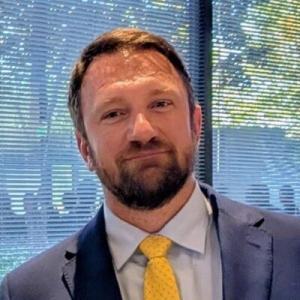 -risk environments, communications must be more than security; they must be reliable, resilient, and aligned to mission requirements. Technical expertise matters. Operational experience matters more.
As Vice President, Programs at CIS Secure, Greg Ebner Jr. is one of those rare engineers with expertise on both sides of the comms. Ebner honed his Radio Reconnaissance, SIGINT and electronic warfare skills serving in the Marines in Afghanistan from 2007-2011. Following his military service, he continued supporting national security missions across counter-unmanned systems efforts, counter-IED efforts, ISR aircraft engineering, and aerial geolocation targeting in support of counternarcotics and counterterrorism operations.
He brings more than a technical understanding of communications systems to his role at CIS Secure. He understands how those systems perform under operational pressure. For over two decades, his work has centered on classified SIGINT and electronic warfare missions, both as an operator and as a provider. That dual perspective informs how CIS Secure develops, tests, and deploys its solutions.
Technology powers secure communications. Operational effectiveness determines whether it succeeds.
Ebner leads a team of more than 160 personnel capable of rapid deployment in support of mission requirements. CIS Secure maintains the ability to deliver mission-ready communications capabilities within 72 hours, supporting customers operating in dynamic environments. But even amid that pace, Ebner keeps the focus where it belongs: on the people his teams are pledged to protect.
When he was contracted to the DEA at another organization, Ebner was deployed in Afghanistan. A high-level Afghani official’s son was kidnapped by the Taliban and time was of the essence to save his life. Using signals intelligence and aerial reconnaissance, the team was able to pinpoint the boy’s location, breach the compound and capture the kidnappers. They found the boy in less than 24 hours after he was taken.
“A lot of that mission was to find bad guys—terrorists, heroin distributors, drug traffickers—and do bad things to them,” recalls Ebner. “But every now and again we would get these kidnapping cases where an innocent life was involved. That’s what made the work and the risk and the time away from home that much more gratifying.”
Advanced communications technologies like those from CIS Secure are critical to today’s arsenal. They’re there to preserve and protect life for the team and the troops they serve. Ebner’s strength is bringing operational experience, technical expertise, and human perspective to teams that can become desensitized to the conflict around them.
Three things to know about today’s contested environments and operational readiness.
Over the course of Ebner’s career, the operational landscape has shifted significantly. Here are three things you should know:
- Near-peer capability has increased. Historically, the U.S. has largely operated with air or ground dominance. Technology has leveled the playing field to a large degree. “Today we’re fighting against drones and technology, in addition to troops. It’s a different battlefield—one where the enemy has more power than in the past.”
- Distributed operations require agile communications. Having compact, high-power communications nodes that remain portable unlock new strategic options. For instance, if there were a war in the Pacific theater, CIS Secure solutions could enable easy island hopping, allowing a commander to establish a communications and intelligence infrastructure quickly in contested environments without needing to contact the rear. “Communications, logistics and more efficient decision-making are how we are winning wars on the back end.”
- Field validation is often insufficient. Many systems are tested in controlled environments but not under realistic operational conditions. This gap can lead to performance shortfalls during deployment. “CIS Secure products are deployed and field tested all over the world. We integrate our services and development teams throughout the entire product lifecycle to ensure our solutions aren’t developed in a vacuum, but in answer to real-world challenges.”
Necessity is the father of invention.
Outside of operational work, Ebner’s interests reflect a hands-on, problem-solving mindset. While deployed, he began home brewing and has since won awards. He is also a hobbyist developer, utilizing software development kits and hardware to test novel ideas related to electronic warfare.
Ebner also spends his time stateside fishing, bow hunting and coaching softball for one of his three daughters’ teams. He holds a Master’s degree in Engineering from Arizona State University.
